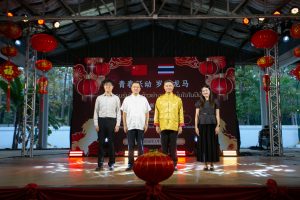
CMU’s International Strategy: A Multi-Tiered Architecture for Global Impact
To realize its vision of becoming a “Leading University Responsible for Society for Sustainable Development, Using Innovation,” Chiang Mai University (CMU) has engineered a sophisticated and multi-tiered international strategy. This is not merely a collection of programs but a cohesive strategic architecture designed to drive ambitious institutional goals, such as breaking into the Top 50 of THE Impact Ranking and generating a 60,000 million Baht socio-economic impact. Each initiative—OFOM, Seed, Person to Organization, and Big Bang—functions as a distinct yet interconnected layer, creating a powerful pipeline that transforms initial contact into high-impact, sustainable global partnerships.
Here is how this innovative ecosystem works:
Tier 1: Foundational Revival – The One Faculty One MOU (OFOM) Program
The OFOM program served as the critical first step in CMU’s post-pandemic strategic revival, addressing the challenge of over 400 inactive international agreements.
- Purpose: To reactivate and re-engage CMU’s vast existing network at the grassroots level.
- Mechanism: By allocating dedicated funds directly to faculties, OFOM empowered those with the deepest subject-matter expertise to rebuild dormant relationships.
- Impact and Scale: This bottom-up approach was a resounding success. The program reactivated 49 MOUs with 46 universities and 3 organizations across 15 countries, demonstrating a truly global reach. It achieved university-wide buy-in, with 33 different faculties and administrative departments participating actively. More importantly, it served as a powerful catalyst, sparking over 56 new project proposals and creating a university-wide culture of proactive international collaboration.
Tier 2: Nurturing Growth – The Seed International Initiatives
Once connections were re-established through OFOM, the Seed program was designed to nurture these budding partnerships and transform them into tangible outcomes.
- Purpose: To provide initial funding that “seeds” promising collaborations, allowing them to develop from concepts into concrete projects with measurable outputs like publications, prototypes, or joint curricula.
- Mechanism: The program funds a wide range of activities, enabling partners to produce early results that are essential for securing larger, external grants in the future.
- Impactful Project Examples:
- Global Health Innovation: In partnership with Tokyo University of Agriculture & Technology, Japan, researchers from CMU’s Faculty of Veterinary Medicine developed a prototype ELISA test kit to diagnose Feline Morbillivirus (FeMV). This project has successfully advanced to the next stage, seeking industrial partnership funding through the Global-CMU Open Innovation Initiative.
- Social Innovation and Cultural Preservation: A collaboration with Saga University, Japan, on the “University-City Model” involved studying the community-based festival model in Kashima to develop innovative, socially-inclusive management models for Chiang Mai’s own cultural festivals. This project directly applies international knowledge to preserve local heritage and is being extended through a Big Bang project.
- Sustainable Agriculture: A project with Nanjing Agricultural University, China, successfully identified value-adding components in over-ripe Thai mango peels, resulting in an international publication and a follow-on proposal to develop innovative prebiotic supplements.
- Environmental Science: Researchers partnered with Nanjing Medical University, China, to conduct a pilot study on detecting microplastics in blood, air, and water samples in Chiang Mai, leading to a joint proposal for a larger grant from national research agencies in both Thailand and China.
- International Curriculum Development: A partnership with the University of Evora, Portugal, led to academic seminars on tourism technology and a joint application for funding from the prestigious ERASMUS+ program to build capacity in higher education.
Tier 3: Proactive Elite Engagement – The Person to Organization (P2O) Program
While OFOM and Seed rebuilt existing networks, the P2O program is CMU’s proactive “headhunting” initiative, designed to forge new alliances with the world’s most prestigious institutions.
- Purpose: To strategically target and establish new collaborations with universities and companies ranked in the global Top 50.
- Mechanism: The university funds its executives and top faculty to leverage their personal contacts and build formal institutional relationships, ensuring CMU is actively creating opportunities with world leaders.
- Impact: This program has successfully established CMU’s presence among the global elite, forging 12 new MOUsfor research, innovation, and academic exchange. Partnerships have been established with a distinguished list of institutions, including ETH Zurich, Imperial College London, King’s College London, The University of Edinburgh, UCLA, Cornell University, The University of Melbourne, and Nanyang Technological University. These elite connections feed the strategic pipeline for deeper, high-impact collaborations.
Tier 4: The Pinnacle of Partnership – The Big Bang International Projects
The Big Bang initiative is the capstone of CMU’s strategy, creating a revolutionary model for deep, sustainable collaborations that generate high-impact outcomes.
- Purpose: To co-invest in high-risk, high-reward projects with world-class partners, focusing on key global challenges such as Carbon Neutrality, AI, Medical & Healthcare, and Future Food.
- Mechanism: The program is defined by three unique and mandatory requirements:
- World-Class Partners: Collaborations are restricted to Top 100 ranked universities or Top 500 companies.
- Mandatory Cash-Matching Investment: International partners must invest their own cash at a level equal to or greater than CMU’s contribution, guaranteeing a shared financial stake.
- Access-Sharing Model: Formal agreements guarantee CMU personnel access to partners’ labs, data, and cutting-edge facilities.
- Impactful Project Examples:
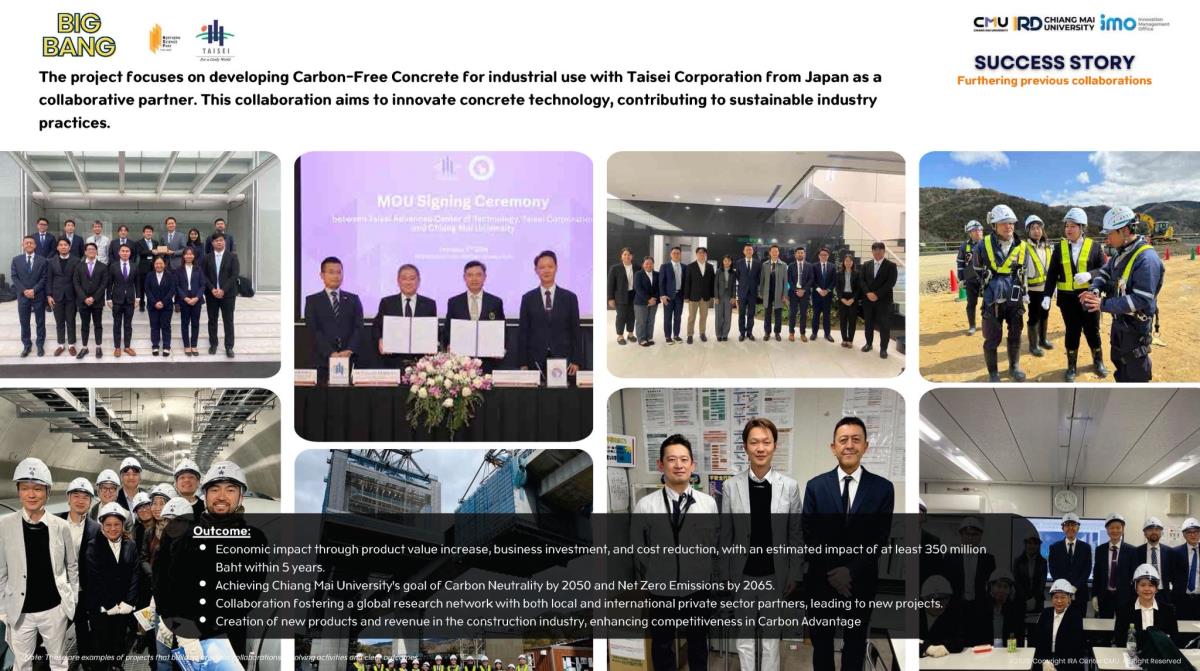
- Industrial Sustainability: A landmark collaboration with TAISEI CORPORATION, Japan, aims to develop “Carbon Free Concrete” using local Thai materials. This project is backed by a 1,000,000 THB matching fund from CMU and includes joint testing and site visits in Japan to ensure technology transfer.
- Global Health (Oncology): A partnership with Imperial College London (QS World Rank #6) is developing revolutionary phage hybrid vectors for targeted gene therapy in bone cancer, aiming to advance the technology towards clinical application.
- Future Food Technology: In collaboration with KU-Leuven, Belgium, researchers are using NIR analysis and AI to develop non-destructive quality control for premium food exports like lychee. This innovation promises to reduce analysis time by 80% and eliminate chemical usage.
- AI and Materials Science: A partnership with the University of New South Wales (UNSW) Sydneyfocuses on applying physics-informed neural networks (PINNs) to analyze advanced microstructures, enhancing CMU’s computational capacity through mandated joint publications.
In synergy, these four tiers create a comprehensive internationalization ecosystem that drives CMU’s institutional vision forward. From reactivating dormant relationships (OFOM) and nurturing their potential (Seed), to proactively seeking elite partners (P2O) and locking in deep, co-invested partnerships (Big Bang), this strategy has yielded exceptional results. It has leveraged a 31.7 million Baht university budget to secure over 17.29 million Baht in external cash funding, producing 41 international journal publications and 7 new joint curricula to date. This ensures that CMU’s global engagement is purposeful, innovative, and directly aligned with its mission to achieve sustainable development through innovation on a global stage.
You may also like
STUDY IN INDIA ICCR SCHOLARSHIPS 2026 – 2027